Every January a wave of "trends to watch" posts appears, and most of them are the same list with the year changed. Progressive web apps. Voice search. Blockchain, for a while there.
So let me be specific about what I mean by a trend. I am talking about changes that altered how we quote projects, how we staff them, and what we ship. Things that showed up in invoices, not just conference talks. Here is what met that bar in 2026.
1. AI stopped being autocomplete and became a team member
This is the big one, and it is easy to be cynical about because the marketing around it has been insufferable.
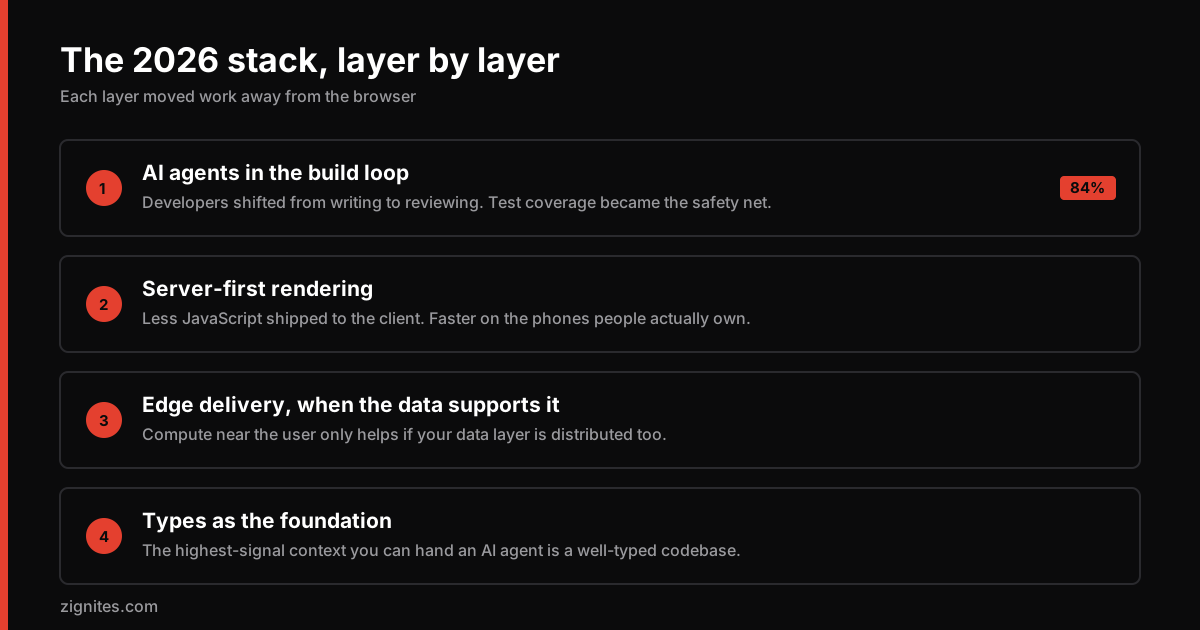
The shift is real though. Two years ago AI in development meant a smarter tab-complete. In 2026 it means agents that take a task, run for twenty minutes, touch fifteen files, run the test suite, and come back with a diff. More than 84% of developers now report measurable productivity gains from AI tooling, and the number is believable because the work has genuinely changed shape.
What actually changed for us: the ratio of writing to reviewing flipped.
A senior developer in 2024 spent maybe 70% of the day writing code and 30% reviewing. In 2026 that is closer to 30/70. You describe intent, an agent produces an implementation, and your job is to know whether it is correct. Which turns out to be a harder skill than writing the code was.
What this means if you are commissioning software
Three practical consequences:
Small teams punch above their weight. A tight team of three with good agentic workflows now delivers what took eight people in 2023. If an agency is quoting you 2023-sized teams for a 2026 project, ask why.
Code review is where the money is now. The bottleneck moved. Ask a prospective partner what their review process looks like, not how many developers they have.
Test coverage stopped being optional. When machines write most of your code, your test suite is the only thing standing between you and a confidently wrong deployment. We treat coverage as a hard gate now, not a nice-to-have.
The developers getting the most out of AI are not the ones who trust it most. They are the ones who verify fastest.
2. The server is taking work back from the browser
For about a decade the industry pushed more and more logic into the browser. Single page apps, client-side routing, state management libraries with their own state management libraries.
That trend has reversed. Modern meta-frameworks now default to doing rendering, data fetching, and caching on the server, and shipping the browser as little JavaScript as they can get away with.
The reason is unglamorous and entirely practical: phones. A mid-range Android device parsing 800 KB of JavaScript is a genuinely bad experience, and Google has been measuring that experience and factoring it into rankings since 2021. Server rendering is not a fashion. It is a response to a measurement.
If you want the full picture of how this connects to search performance, we go deeper in our guide on passing Core Web Vitals on real phones.
The practical version
// 2022 pattern: fetch on the client, spinner, hydrate, hope
export default function ProductPage({ id }) {
  const [product, setProduct] = useState(null)
  useEffect(() => {
    fetch(`/api/products/${id}`)
      .then(r => r.json())
      .then(setProduct)
  }, [id])
  if (!product) return <Spinner />
  return <ProductView product={product} />
}

// 2026 pattern: it is already there when the HTML arrives
export default async function ProductPage({ params }) {
  const product = await getProduct(params.id)
  return <ProductView product={product} />
}
The second version ships less JavaScript, has no loading state, has no waterfall, and is indexable without the crawler needing to execute anything. It is not a stylistic preference. It is measurably faster on the devices your customers actually own.
3. TypeScript stopped being a debate
I am including this not because it is new but because the argument is finally over. In 2026, starting a non-trivial JavaScript project without types is a choice you have to justify, rather than the default.
Part of this is AI-driven, which is an underrated point. Type annotations are the highest-signal context you can hand an agent. A well-typed codebase gets dramatically better AI-generated code than an untyped one, because the model has a contract to work against instead of guessing from variable names.
If you have an untyped codebase and you are planning to lean on AI tooling, incremental typing is probably the highest-leverage refactor available to you right now.
4. Edge runtimes went from exotic to default
Running code geographically close to the user used to require thinking about it. Now it is often the deployment default, and you have to opt out.
The honest caveat: edge is not automatically faster. Edge functions have constrained runtimes, cold starts of their own, and if your database sits in one region then running compute in twenty regions just means nineteen of them are making long round trips. Edge helps when the work is genuinely stateless or when your data layer is distributed too.
We have seen teams move to edge, get slower, and not understand why. The database was in Virginia the whole time.
5. Accessibility got teeth
The European Accessibility Act became enforceable in June 2025, and 2026 is the first full year of consequences rather than warnings. For anyone selling into the EU, accessibility moved from an ethical argument to a compliance line item.
The useful reframe: most accessibility work is just good engineering. Semantic HTML, keyboard navigation, sufficient contrast, focus states that exist. Teams that were already doing this had almost nothing to fix. Teams that shipped div soup with click handlers had a rough year.
6. "SEO" quietly became something broader
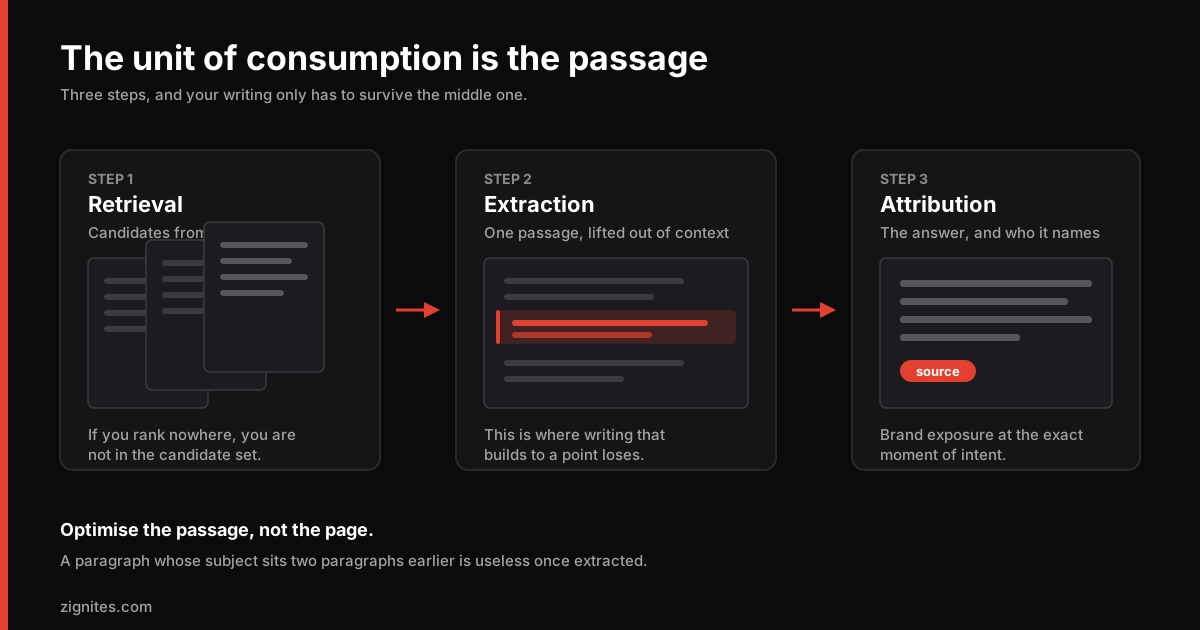
Search is not one box anymore. It is Google's AI Overviews, ChatGPT's search, Perplexity, and whatever the assistant on someone's phone is doing. These systems do not rank pages so much as extract meaning from them and decide whether to cite you.
That rewards a specific kind of content architecture: clean structure, real semantic markup, fast responses, unambiguous facts. It punishes content that only makes sense to a human reading a rendered page.
We wrote about the content architecture side of this in why AI search rewards structured content.
What we would actually tell a client in 2026
Cutting through it:
Worth your budget this year
Migrating to server-first rendering if you are on a heavy client-side SPA
Typing your codebase, especially before you invest in AI tooling
Accessibility remediation if you touch EU customers
Structured data and semantic markup, because AI search is now a real traffic source
Not worth it yet
Rewriting a working application in whatever framework launched last quarter
Edge deployment without a distributed data layer
Any AI feature where you cannot name the specific problem it solves for a specific user
The thing nobody puts on a trends list
Your dependency graph. The average project pulls in hundreds of packages, most of them unaudited, several of them abandoned. Supply chain attacks got more common in 2026, not less. An afternoon spent auditing dependencies will do more for your risk profile than any trend on this page.
Where this leaves you
The pattern across all six of these is the same. The industry spent a decade adding layers, and 2026 is a year of removing them. Less client JavaScript. Fewer hand-written lines. Fewer unaudited dependencies. Fewer assumptions that the user is on desktop fibre.
That is a good direction. It means the projects that win are the ones with clear thinking behind them, not the ones with the longest tech stack.
If you are weighing a build or a rebuild this year and want a straight answer about which of these actually applies to your situation, tell us what you are working on. We would rather talk you out of an unnecessary rewrite than sell you one.
Common questions
What are the biggest web development trends in 2026?
The six that changed how projects actually get built and budgeted: AI agents handling multi-step implementation work, server-first rendering taking work back from the browser, TypeScript becoming the default rather than a debate, edge runtimes shipping as standard, accessibility becoming legally enforceable in the EU, and search fragmenting across multiple AI surfaces.
Is AI replacing web developers in 2026?
No, but it changed the job. The ratio of writing code to reviewing code has roughly inverted, from about 70/30 writing-to-reviewing in 2024 to closer to 30/70 in 2026. Developers now spend most of their time verifying agent-generated implementations, which is a harder skill than writing the code was. Over 84% of developers report productivity gains, but those gains go to teams with strong review processes and real test coverage.
Should I rewrite my application in a new framework in 2026?
Almost never. Rewriting a working application because a newer framework exists is the most common expensive mistake we see. The changes worth budget this year are migrating from heavy client-side rendering to server-first, adding types to an untyped codebase, and auditing your dependency graph. None of those require a rewrite.
Keep reading