There is a specific kind of Search Console report going around in 2026. Impressions flat or up. Clicks down, sometimes badly. Rankings unchanged.
Nothing broke. Your page is still there, in the same position. Something now sits above it that answers the question, and most people stop reading at that point.
Pew Research put numbers on it. Analysing roughly 70,000 Google searches from around 900 US adults, they found that searches without an AI Overview produced an organic click about 15% of the time. With an AI Overview present, that halved to around 8%. Links inside the AI Overview itself were clicked in roughly 1% of cases. And session abandonment rose from 16% to 26%.
Read that last one again. When an AI Overview appears, users are noticeably more likely to end their browsing session entirely. The answer was sufficient.
This post is about what to actually do, which is narrower and less exciting than most of what is being sold as "GEO."
First, the honest framing of the opportunity
Two things are true at once and most articles pick one.
The traffic loss is real. Halved click-through on affected queries is a large effect, and it lands hardest on informational content that answers a question completely. If your traffic came from "what is X" queries, that traffic is structurally reduced and it is not coming back.
The referral traffic is real but small. Analysis of 6.77 million LLM-driven sessions across 166 websites found ChatGPT accounts for roughly 92% of trackable standalone LLM referral traffic, growing sharply. But standalone LLM referrals remain a fraction of what search sends, and Google's own AI features (AI Overviews, AI Mode) do not produce trackable referral sessions in the same way, which means the largest slice of AI-influenced traffic is the slice you cannot measure.
So the honest position: you are optimising partly for a channel you can measure and partly for one you cannot, and the primary return is not clicks. It is being the source that gets named.
Being cited in an answer someone reads is brand exposure at the exact moment of intent. It does not show up in your analytics. It shows up months later when someone types your name into Google directly, which is measurable, and is the metric worth watching.
Let us deal with llms.txt
You have probably been told to add one. It is the most-recommended and least-effective item on most GEO checklists.
The proposal is a markdown file at your root that tells language models what your site contains and where the important content lives. It is a reasonable idea, borrowing the shape of robots.txt.
Google has stated explicitly that llms.txt receives no special treatment in Google Search, including its generative AI features. No major search engine has committed to honouring it as a ranking or retrieval input.
There is a second problem that gets less attention. A separate llms.txt describing your content is a second source of truth that will drift from the first. You update a page, you forget the file, and now you are publishing a stale description of your own site.
Our position: it costs almost nothing and does no harm, so add it if you like. Do not count it as work done, and do not let it displace anything on the list below. If someone is charging you for GEO and llms.txt is a headline deliverable, that is a useful signal about the rest of the engagement.
How citation selection actually works
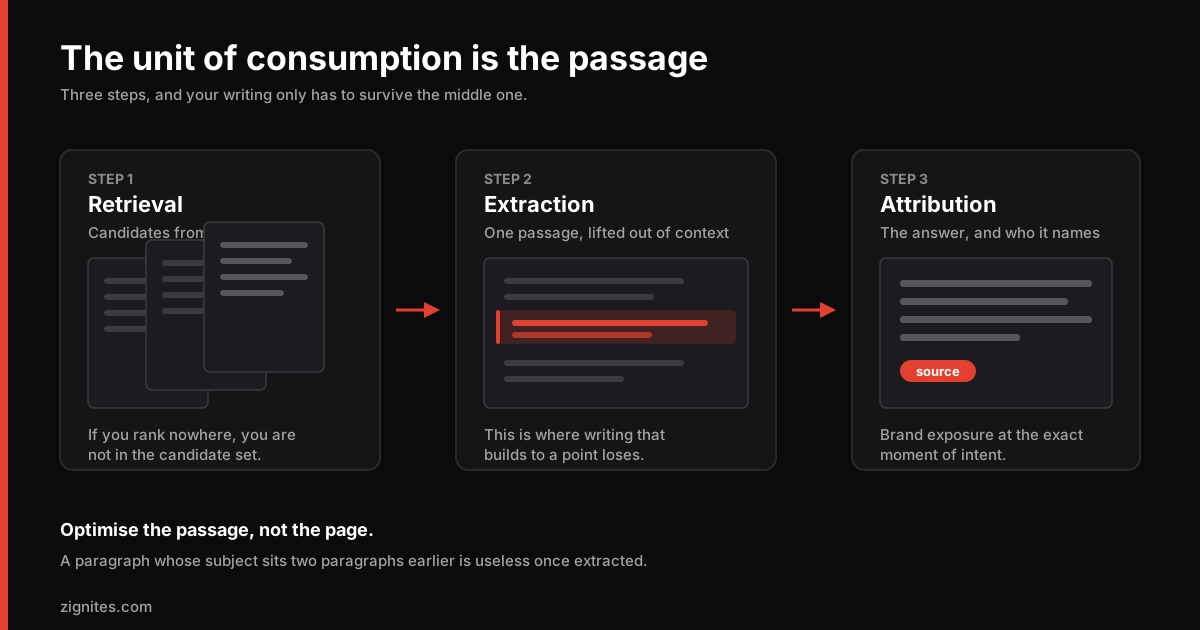
Underneath the branding, every AI answer engine does roughly the same three things.
Retrieval. It finds candidate documents, usually through a conventional search index, sometimes through its own crawl or a partner feed. Conventional search visibility is still the entry ticket. A page that ranks nowhere is rarely retrieved.
Extraction. It pulls specific passages from those candidates. Not pages, passages. This is the step most content is unprepared for.
Synthesis and attribution. It writes an answer from the extracted passages and attributes some of them.
The practical consequence: you are not optimising a page, you are optimising individual passages to survive being lifted out of context.
A paragraph that reads well in sequence, where "this approach" refers to something two paragraphs earlier, is nearly useless once extracted. A paragraph that states its own subject and delivers a complete claim can stand alone in an answer. That is the whole game, and it is mostly a writing problem rather than a technical one.
What actually moves the needle
Six things, ordered by return on effort.
1. Answer the question in the first two sentences
Under each heading, state the answer immediately, then explain. The inverted pyramid, applied at section level rather than article level.
This runs against how most people write, which builds toward a conclusion. An extraction system reading a section that builds toward its point will pull the build-up.
Bad: There are several factors to consider when evaluating this, and the answer depends on your circumstances...
Good: Under 200 milliseconds at the 75th percentile is a good INP score. Between 200 and 500 needs improvement. Above 500 is poor.
The second one is quotable. The first one is filler that happens to be grammatically correct.
2. Make headings match real questions
## What is a good INP score? gets retrieved. ## Understanding the metrics does not. Headings are a strong retrieval signal because they declare what the passage below is about.
Use the phrasing people actually type or say. Question-form headings are not a stylistic choice here, they are a matching mechanism.
3. Put facts in tables and lists
Structured content extracts cleanly and is disproportionately likely to be quoted. A comparison written as three flowing paragraphs is hard to lift. The same comparison as a table with clear column headers is a ready-made answer.
This is the single easiest change to make to existing content and it takes an afternoon.
4. Ship real schema, especially FAQPage and Article
Structured data gives machines an unambiguous reading of what your page contains: what is a question, what is the answer, who wrote it, when it was updated.
Article, FAQPage, BreadcrumbList and Organization are the meaningful set for most content sites. Implement them properly and validate them. And do not mark up content that is not visibly on the page, which is both a guideline violation and the kind of shortcut that earns manual actions.
We went deeper on the content architecture behind this in headless CMS and AI search. Content stored as structured data rather than as pages is far easier to expose in the shapes machines want.
5. Be specific enough to be worth citing
Answer engines synthesise from multiple sources. Content that repeats the consensus adds nothing to synthesise, so it does not get named.
What gets cited is specificity: a number, a named threshold, a documented result, a distinction nobody else drew. Generic advice does not survive synthesis because it is already in the model.
This is the part that cannot be systematised. It requires actually knowing something.
6. Get mentioned in places that get retrieved
Retrieval favours sources the system already trusts. Being referenced on established sites, in documentation, in community discussions and in industry publications raises the probability that you appear in the candidate set at all.
This is unglamorous and slow, and it is the highest-ceiling item on the list. It is also the one nobody can sell you as a deliverable.
What to stop doing
Do not block the AI crawlers by reflex. GPTBot, ClaudeBot, PerplexityBot and the rest. There is a legitimate argument for blocking, and if you sell your content you should probably block. But blocking removes you from the candidate set entirely. If you want citations, you have to be crawlable. Decide deliberately rather than copying a robots.txt from a blog post.
Do not write for length. Padding a 900-word answer to 2,500 words was a search-era tactic. Extraction systems do not reward it, and a diluted answer is a worse candidate than a dense one.
Do not buy "GEO" that is repackaged content marketing. If the deliverable list is keyword research, blog posts and an llms.txt file, you are buying SEO with new labels. The genuinely new work is structural: passage-level writing, schema, and being specific enough to be worth quoting.
How to measure something you cannot track
Referral data undercounts badly, so build the picture from four angles.
Signal | Where | What it tells you |
|---|---|---|
Branded search volume | Search Console, queries containing your name | The clearest proxy. Citations produce name recall, which produces branded search weeks later. |
Direct traffic to deep pages | Analytics | People landing on /blog/specific-post with no referrer are often arriving from an AI answer. |
AI crawler hits | Server or edge logs | GPTBot, ClaudeBot, PerplexityBot. Tells you whether you are in the corpus at all. |
Manual spot checks | Ask the assistants your target questions monthly | Crude, but it is the only direct read on whether you are named. |
Set a baseline now. The trend is the only thing that will be interpretable, and you cannot construct a baseline retroactively.
The realistic summary
Most of what makes content citable is what made it good before: answer the question, be specific, structure it clearly, know something worth knowing. The genuinely new part is writing at passage level rather than page level, because the unit of consumption changed.
It is worth noticing how much of that list is the same work as making a page accessible. Meaningful heading structure, unambiguous labels and content that does not depend on visual context are what a screen reader needs and what an extraction system needs, which is a point we come back to in the European Accessibility Act post.
The traffic loss on informational queries is structural. The compensation is being named in the answer, which builds brand rather than sessions, on a slower and less measurable curve.
Anyone selling you certainty about this is selling you something. The systems are opaque, they change monthly, and nobody outside those companies knows the retrieval weights.
If your Search Console is showing the pattern at the top of this post and you want an outside read on whether it is an AI Overview problem or something else, send us the property. We will look at the query-level data and tell you which it is. More on how we build for this on our web development services page, and the architecture side is covered in what actually changed in web development in 2026.
Common questions
How do I get my content cited by ChatGPT and AI Overviews?
Write so that individual passages survive being lifted out of context. Answer the question in the first two sentences under each heading, use question-form headings that match how people actually ask, put comparable facts in tables, and ship valid Article and FAQPage schema. Then be specific enough to be worth citing, because answer engines synthesise from multiple sources and generic content adds nothing to synthesise.
Does llms.txt actually work?
There is no evidence that it does. Google has stated that llms.txt receives no special treatment in Google Search, including its generative AI features, and no major engine has committed to using it for retrieval or ranking. It costs almost nothing to add, but it should not displace anything else on your list, and a separate file describing your content will drift out of sync with the content itself.
How much traffic do AI Overviews actually cost?
Pew Research analysed roughly 70,000 Google searches from around 900 US adults and found organic click-through fell from about 15% on searches without an AI Overview to about 8% on searches with one. Links inside the AI Overview were clicked in roughly 1% of cases, and session abandonment rose from 16% to 26%.
Should I block AI crawlers like GPTBot and ClaudeBot?
Only if you have decided that protecting your content matters more than being cited, which is a legitimate position for publishers who sell access. Blocking removes you from the candidate set entirely, so you cannot be cited by a system that cannot read you. Make it a deliberate commercial decision rather than copying a robots.txt from a blog post.
Is GEO different from SEO?
Mostly not. Conventional search visibility is still the entry ticket, because retrieval usually runs through a search index. The genuinely new work is at passage level: writing sections that stand alone when extracted, structuring facts so they can be lifted cleanly, and being specific enough that synthesis has something to draw on. If a GEO proposal is keyword research, blog posts and an llms.txt file, it is SEO with new labels.