For most of the last decade, the argument for headless CMS was developer experience. Nicer APIs, framework freedom, no PHP templates. Real benefits, but not the kind that wins a budget conversation with a CFO.
The argument changed in 2026, and it changed because of where traffic comes from now.
Search is no longer one box on one site. It is Google's AI Overviews, ChatGPT's search, Perplexity, and whatever assistant is running on someone's phone. These systems do not rank ten blue links so much as read your content, extract meaning from it, and decide whether it is worth citing.
And they are markedly better at reading content that was stored as structured data than content that was stored as a rendered page.
That is the shift. The headless CMS market is forecast to grow from $3.94 billion in 2025 to $22.28 billion by 2034, roughly a 22.6% compound rate, and this is a large part of why.
The actual difference, without the vendor language
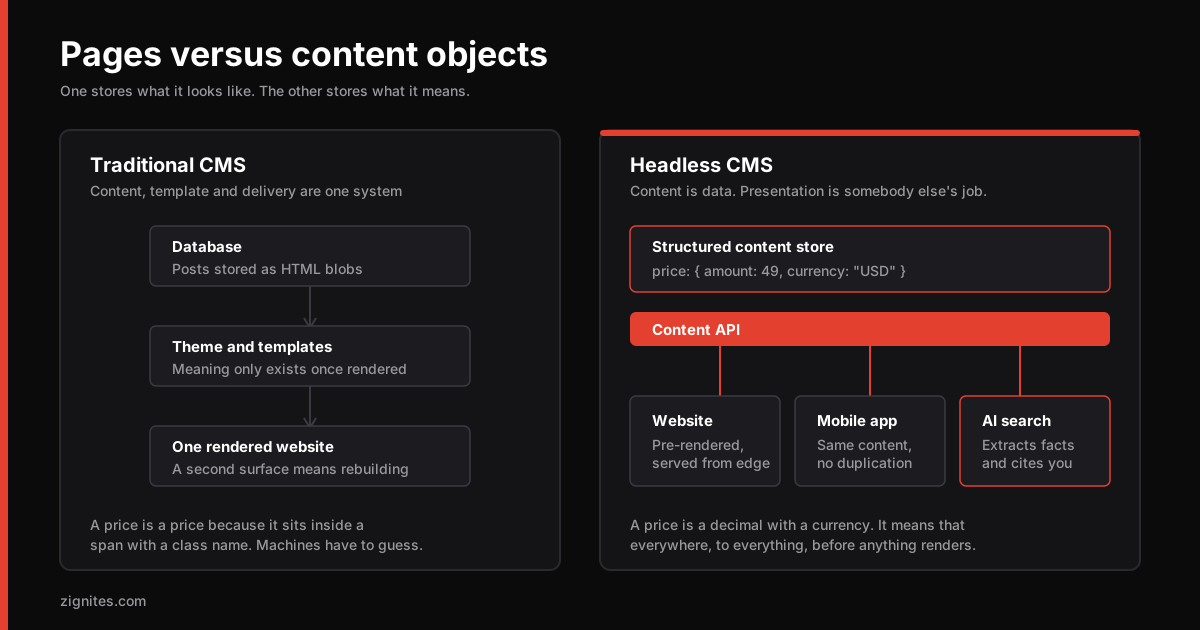
A traditional CMS stores a page. The content, the layout, the presentation logic and the delivery are one coupled system. WordPress stores post content as a blob of HTML mixed with shortcodes, and a theme turns it into a page.
A headless CMS stores content objects. A product has a name, a price, a description, a set of specifications, and relationships to other objects. What it looks like is a separate concern handled by whatever is consuming the API.
The consequence people underrate: in the traditional model, the meaning of your content only exists once it is rendered. A price is a price because it sits inside a <span class="price"> in a template. In the headless model, a price is a price field of type decimal with a currency, and it means that everywhere, to everything, before any rendering happens.
Why this matters to AI search specifically
AI search systems are semantic retrieval systems. They want to answer a question and cite a source. To do that reliably they need to extract unambiguous facts.
Consider two versions of the same content.
Traditional:
<div class="entry-content">
  <p>Our Pro plan is just $49 a month and includes unlimited
  projects, priority support and our new analytics suite.</p>
</div>
Structured:
{
  "planName": "Pro",
  "price": { "amount": 49, "currency": "USD", "interval": "month" },
  "features": ["Unlimited projects", "Priority support", "Analytics suite"],
  "supportTier": "priority"
}
A human reads both identically. A retrieval system reads the second one with certainty and the first one with a probability. When it has to choose which source to cite for "how much does Zignites Pro cost," certainty wins.
This also feeds directly into schema markup. When your content is already structured, generating accurate JSON-LD is a mapping exercise. When it is a blob of HTML, generating schema means parsing your own prose and hoping.
The question is no longer "does my page rank." It is "can a machine extract a correct, citable fact from my content without guessing."
Where headless genuinely wins
Multiple output surfaces. Website, mobile app, in-product help, partner API, digital signage, an internal search index. Write once, deliver everywhere. If you have two or more surfaces, this alone usually justifies it.
Performance. Decoupling lets you pre-render and serve from a CDN edge. There is no database query on a page view. This connects directly to your Core Web Vitals scores, which we cover in passing Core Web Vitals on real phones.
Security surface. Your content editing interface is not on the same host as your public site. There is no public /wp-admin to attack. For businesses that have lived through a compromised CMS, this argument lands hard.
Framework independence. You can rebuild the frontend in 2029 without migrating content. Content outlives frontends, and if they are coupled, every redesign is a migration.
Localisation. Field-level translation with proper fallback chains is a solved problem in headless platforms. In coupled systems it is usually a plugin held together with hope.
Where headless is the wrong answer
I want to be straight about this, because the trend has developed a bandwagon and bandwagons cost people money.
You have one website and no plans for a second surface. The primary architectural benefit of headless is multi-channel delivery. If you have one channel, you are paying complexity for something you are not using.
Your marketing team needs to build pages without a developer. This is the real cost of headless and vendors soft-pedal it. Traditional CMS platforms give non-technical users genuine page-building autonomy. Headless increases dependency on developers, needs new operational skills, and changes how projects get planned. Visual editing in headless platforms has improved a lot, but "improved" is not the same as "matches a mature page builder."
Your total content is under fifty pages and rarely changes. Static files in a repository will serve you better than any CMS. Fewer moving parts, no subscription, nothing to update.
You do not have developer capacity. Headless assumes there is someone to build and maintain the frontend. If that person does not exist or is already at capacity, you are choosing an architecture your organization cannot operate.
The middle path more people should consider
Headless and traditional are not the only options. There is a third that fits a lot of real businesses.
Traditional CMS running headless. WordPress with its REST API or WPGraphQL, feeding a Next.js frontend. Your editors keep the interface they know. You get decoupled delivery, edge caching and framework freedom. Costs stay low because you are not adding a SaaS content subscription. Before committing either way, it is worth knowing what the existing install is carrying: our free WordPress plugin checker lists the plugins a public site loads and flags the ones nobody has updated in years.
The trade-off is that you are still carrying WordPress's data model, which is genuinely page-shaped underneath. Custom fields get you most of the way to structured content, but not all of it.
We build this configuration frequently, and for mid-sized businesses with an existing WordPress investment and an editorial team who do not want to relearn their job, it is often the correct answer rather than the compromise answer.
Git-based CMS. Content as Markdown or MDX files in your repository, with a lightweight editing interface layered on top. Content is versioned alongside code, reviewable in pull requests, and costs nothing to store. Excellent for documentation and engineering-led content. Poor for teams where marketing needs to publish without touching a repository.
If you do go headless, model your content properly
The most common failure we see is not choosing headless. It is choosing headless and then modelling content as if it were still pages.
If your content model has a field called bodyHtml containing a wall of markup, you built a traditional CMS with extra steps and paid for the privilege.
Some principles that hold up:
Model the thing, not the layout. A Product has a price and specifications. It does not have a heroSection or a rightColumn. The moment layout enters your content model, you have coupled content to one presentation again.
Make relationships explicit. An author is a reference to an Author object, not a string. A related article is a reference, not a manually maintained list of URLs. This is precisely the relational meaning that AI retrieval systems use.
Use the right field types. A date is a date field, not a string. A price is a number with a currency, not "$49/mo". Every time you store a fact as free text you throw away machine readability.
Keep rich text for actual prose only. Rich text fields are where structure goes to die. Anything that is a discrete fact should be its own field.
Design for reuse from the start. If the same product description appears on the site, in the app and in a sales PDF, it should exist once. That is the entire point of the architecture.
How this connects to the rest of your stack
Content architecture is one piece. The broader pattern in 2026 is that everything is moving toward being machine-readable and server-resolved, which we cover across what actually changed in web development this year.
Structured content, semantic markup, server-side rendering and fast delivery are not four separate initiatives. They are one initiative viewed from four angles, and the payoff is the same in each case: your content becomes something machines can use confidently, at a moment when machines are increasingly the ones deciding who gets seen.
The short version
Choose headless if you have multiple delivery surfaces, developer capacity to maintain a frontend, content that is genuinely structured rather than page-shaped, and a real stake in AI search visibility.
Stay traditional if you have one website, an editorial team that values independence, and no immediate multi-channel need. There is no prize for architectural sophistication you are not using.
Consider the middle path if you have an existing WordPress investment, a team that knows it, and a need for better performance and delivery flexibility. This is where a lot of businesses actually belong and few consultants suggest it.
If you want an outside opinion on which of the three fits your situation, describe your setup to us. We will give you a straight recommendation, including when that recommendation is "keep what you have."
Common questions
Is headless CMS good for SEO?
It helps, but indirectly rather than as a ranking factor in itself. The benefits come from what headless enables: pre-rendered pages served from a CDN edge, which improves Core Web Vitals, and content stored as structured data, which makes accurate schema markup straightforward. That structure also matters for AI search surfaces like AI Overviews, ChatGPT search and Perplexity, which extract facts and decide whether to cite you. A badly implemented headless build can rank worse than a well-tuned traditional CMS, so the architecture is an enabler, not a guarantee.
What is the difference between a CMS and a headless CMS?
A traditional CMS stores and renders pages, coupling content, template and delivery in one system. A headless CMS stores content as structured objects with typed fields and relationships, and delivers them over an API to whatever consumes them. The practical difference is that in a traditional CMS the meaning of your content only exists once it is rendered, while in a headless CMS a price is a decimal with a currency before anything renders.
When should you not use a headless CMS?
When you have one website and no plans for a second delivery surface, when your marketing team needs to build pages without a developer, when your total content is under about fifty pages and rarely changes, or when you do not have developer capacity to build and maintain a frontend. Headless increases developer dependency, and that cost is real.
Can you run WordPress as a headless CMS?
Yes, using the REST API or WPGraphQL with a separate frontend such as Next.js. Editors keep the interface they already know, you get decoupled delivery and edge caching, and you avoid a separate content subscription. The trade-off is that WordPress's underlying data model is still page-shaped, so custom fields get you most of the way to structured content but not all of it. For many mid-sized businesses this is the right answer rather than the compromise answer.
Keep reading