Search this question and you will find forty articles that all cite the same statistic: Flutter at around 46%, React Native at around 35%.
That number comes from a Statista developer survey, and it is not market share. It is a multi-select question asking which frameworks developers have used. Developers use more than one. The percentages do not describe a market being divided, they describe overlapping familiarity, and the figure has been repeated as market share so many times that it now appears in comparison tables as though it settles something.
It settles nothing, and neither does any benchmark you will find. Both frameworks are fast enough for almost every app anyone reading this will build. The decision is made somewhere else entirely.
The decision is about your team, not the framework
Here is the uncomfortable version, stated up front.
If your team writes TypeScript and React every day, React Native is the right answer for you, almost regardless of what a benchmark says. Your developers are productive on day one, your state management patterns transfer, your linting and testing conventions transfer, and you can share validation logic and types with a web app.
If your team has Dart or strong object-oriented backgrounds and no React investment, Flutter is the right answer. Its widget model is coherent, its tooling is excellent, and the rendering approach removes an entire category of platform inconsistency bugs.
If you have neither, hiring availability decides it. React Native draws from the much larger pool of JavaScript and React developers, which matters when someone leaves.
Everything below refines that. None of it overturns it.
What actually changed, and it is significant
If your view of React Native was formed before 2025, it is out of date in a way that matters.
The bridge is gone. React Native's New Architecture (JSI, Fabric and TurboModules) became the default in 0.76, released in October 2024. Version 0.82, in October 2025, went further and removed the ability to opt back out: the New Architecture is not the default any more, it is the only one, and the legacy code has been coming out of the codebase in the releases since. The old asynchronous JSON bridge, which was the technical basis for most "React Native feels janky" complaints, is no longer in the path. JavaScript can call native synchronously.
This closed the gap that the framework argument was largely built on. Objections that were fair in 2022 are now describing software that is not shipping.
Expo became the default path. For most teams, "React Native" in practice now means Expo. Managed builds, over-the-air updates, file-based routing, and a native module story that no longer requires opening Xcode for routine work. Recent SDK releases track React Native closely rather than lagging it. Choosing bare React Native over Expo is now a decision that needs justifying, which is a reversal from a few years ago.
Flutter kept its core advantage. Flutter renders everything itself rather than mapping to platform components. That is why a Flutter UI is identical across platforms and why complex custom animation is more predictable to build. It is also why Flutter apps historically felt slightly non-native, though the current Material and Cupertino implementations are close enough that most users do not notice.
Native tooling improved enough to matter. SwiftUI and Jetpack Compose are both mature declarative frameworks now. The productivity argument for cross-platform is narrower than it was, particularly for a single-platform app.
The honest comparison
React Native (Expo) | Flutter | Native (Swift / Kotlin) | |
|---|---|---|---|
Language | TypeScript | Dart | Swift, Kotlin |
Rendering | Real platform components | Own engine, draws everything | Platform native |
UI consistency across platforms | Follows each platform | Pixel-identical everywhere | N/A |
Team ramp-up from web | Very fast | Moderate, new language | Slow |
Code shared with web app | Logic, types, validation | Flutter Web, viable but a separate consideration | None |
Over-the-air updates | Mature via Expo | Available, less established | Not permitted for logic changes |
Complex custom animation | Good, Reanimated is strong | Excellent, the clear strength | Excellent |
Day-one platform API access | Usually needs a package or wrapper | Usually needs a plugin or channel | Immediate |
Hiring pool | Largest | Growing, smaller | Platform-specific, expensive |
Best fit | Product apps, teams with React | Design-heavy or animation-heavy apps | Hardware, background, platform-defining apps |
When native is still the right answer
Cross-platform is the default for good reasons, but there are cases where it is the wrong call and choosing it costs more than it saves.
Sustained heavy background work. Continuous location tracking, background audio processing, health data integration, anything with strict energy budgets. Both platforms have intricate background execution rules and you will spend more time fighting the abstraction than the abstraction saves.
Hardware-intensive features. Custom camera pipelines, real-time computer vision, Bluetooth Low Energy with unusual peripherals, AR. You will end up writing native modules for the hard parts, at which point you have two codebases with a bridge between them.
Day-one adoption of new OS features. If your product needs the new widget API the week it ships, you need native. Cross-platform support arrives on a lag.
Genuinely single-platform products. An internal iOS-only tool has no cross-platform benefit to collect. SwiftUI is a pleasure to build in and you skip a layer.
Apps where the interface is the product. Some things are worth building twice.
For the large middle (a product app with lists, forms, auth, navigation, payments, notifications, an API behind it) cross-platform is correct and the argument is mostly over.
Choosing between the two, in order
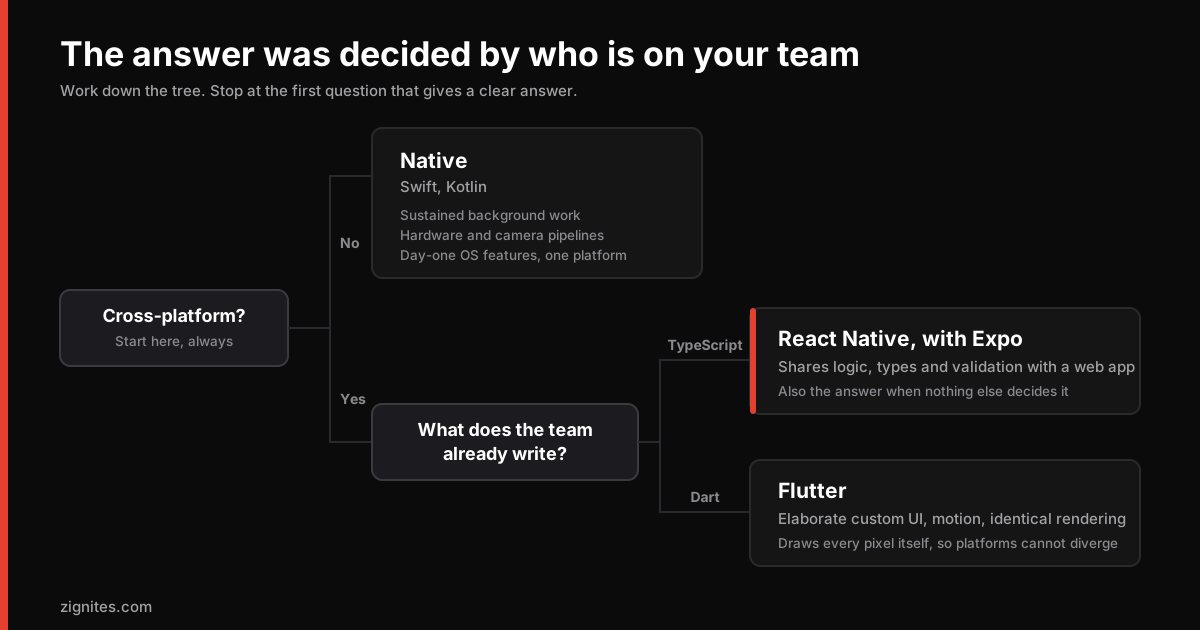
If cross-platform is right, work down this list. Stop at the first question that gives a clear answer.
1. What does your team already write? React and TypeScript means React Native. Dart or strong OO background with no React investment means Flutter. This resolves the majority of real decisions.
2. Is there a web app to share with? React Native lets you share validation schemas, types, API clients and business logic with a React web app. That is a compounding advantage that grows with the codebase and it is the strongest argument in React Native's favour for product teams.
3. How much custom animation and bespoke UI? If the design is an elaborate custom interface with heavy motion, Flutter's rendering control makes it more predictable. If it is standard product UI, React Native follows platform conventions, which users generally prefer without being able to say why.
4. Does UI need to be identical across platforms, or native to each? Genuinely a preference, and worth deciding explicitly rather than discovering in review. Flutter gives you identical. React Native gives you native-feeling.
5. Who are you going to hire? In most markets React Native draws from a larger pool because JavaScript developers outnumber Dart developers by a wide margin. Check your own market rather than trusting a global figure.
If you reach question five with no clear answer, pick React Native. Not because it is better, but because the hiring pool is deeper and framework choice is more reversible than team composition.
The things that will actually hurt you
The framework decision is not the one that goes wrong. These are.
Navigation architecture decided late. Retrofitting deep linking, auth-gated routes and tab state persistence onto a navigation structure that grew organically is one of the more painful refactors in mobile work. Design it before you build the second screen.
Offline behaviour treated as a later feature. Mobile networks fail constantly. If your app assumes connectivity, users will hit failures daily. Decide early what is cached, what queues, and what is simply unavailable. Bolting this on afterwards means touching every data path you own.
No release automation. App store submission is tedious and error-prone by hand. Set up automated builds and signing before your first release, not after your fifth.
Ignoring app size. Install conversion drops as size grows, and this effect is much stronger on mid-range Android in markets with expensive data. Both frameworks add baseline weight. Watch it from the start.
Testing only on a recent iPhone. The performance and layout problems live on three-year-old Android hardware, which is what a large share of your users have. This is the same 75th-percentile trap we wrote about for the web in mobile-first design and Core Web Vitals, and it applies identically to native apps.
Treating accessibility as a launch-blocker you can defer. Both frameworks expose the platform accessibility APIs, and both make it easy to ship a custom component that is invisible to a screen reader. If the app is a consumer service sold into the EU, this is now a legal question as well as a quality one, which we covered in the European Accessibility Act post.
No crash reporting from day one. Ship without it and your first production bug report will be a one-star review that says "keeps crashing" and nothing else.
What we would pick, and why
For a product app in 2026, for a team that is not already fluent in Dart: React Native with Expo.
The reasoning is not that it wins benchmarks. It is that the New Architecture removed the performance objection, Expo removed most of the tooling pain, the hiring pool is the deepest, and the shared logic with a web codebase compounds over the life of the product.
We would pick Flutter without hesitation for an app where the interface is elaborate and custom, where motion design is central, and where identical rendering across platforms is a requirement rather than a preference.
We would pick native when the app lives close to the hardware or the operating system, and we would say so early rather than discovering it in month four.
The mistake worth avoiding is not picking the wrong framework. It is spending three weeks deciding, when the answer was determined on day one by who is on your team.
If you are scoping an app and want a second opinion on the stack before you commit, tell us what it does. Twenty minutes usually settles it. More on how we build these on our mobile app development page.
Common questions
Is Flutter more popular than React Native?
The commonly cited figures (Flutter around 46%, React Native around 35%) come from a Statista developer survey that asks which frameworks developers use, allowing multiple answers. It is not market share, and the percentages overlap. Both frameworks are widely used in production. React Native draws from the larger JavaScript and React hiring pool, which usually matters more to a team decision than adoption figures do.
Is React Native still slow in 2026?
No. The New Architecture (JSI, Fabric and TurboModules) became the default in React Native 0.76 in October 2024, and version 0.82 removed the option to fall back to the legacy architecture at all. The asynchronous JSON bridge that caused most historical performance complaints is no longer in the path, and JavaScript can now call native code synchronously. Objections formed before 2025 describe software that is no longer shipping.
Should I use React Native or Flutter?
Start with your team. If they write React and TypeScript, choose React Native, because they are productive immediately and can share logic, types and validation with a web codebase. If they have Dart or strong object-oriented backgrounds and no React investment, choose Flutter. If the app is animation-heavy with an elaborate custom interface, Flutter's rendering control makes it more predictable. If none of that decides it, choose React Native for the deeper hiring pool.
When should I build a native app instead of cross-platform?
When the app does sustained background work like continuous location tracking or audio processing, when it is hardware-intensive with custom camera pipelines or Bluetooth peripherals, when you need new OS features the week they ship, or when it targets a single platform only. For a typical product app with lists, forms, authentication, navigation, payments and an API behind it, cross-platform is the correct default.
What is the most common mobile development mistake?
Deciding navigation architecture late. Retrofitting deep linking, auth-gated routes and tab state persistence onto a structure that grew organically is one of the most painful refactors in mobile work. Second is treating offline behaviour as a later feature, which means touching every data path in the app to fix.